The Civil War in Missouri
Save ThisMy CollectionCamp Jackson
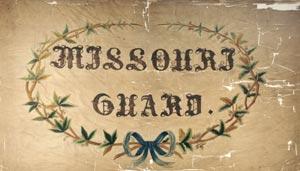
Flag of the Missouri Guard, Company G of the 1st Regiment (Download 1.9 MB PDF)
Capture
Highlights
In-Depth
Governor Jackson in his desire to pull Missouri from the Union had plans to take the weapons stored at the U.S. Arsenal in St. Louis. In early 1861 it seemed likely that he would succeed, as the arsenal was guarded by only 40 men, and the leadership of the arsenal seemed friendly toward Jackson and his military commander, General Frost.
On April 23, Jackson refused to meet President Lincoln’s call for troops. Instead, he ordered the Missouri Volunteer Militia to muster all across the state. In answer to Gov. Jackson’s call, close to 1,000 men made camp in St. Louis’s Lindell Grove. Captain Nathaniel Lyon, the commander of the St. Louis Arsenal, considered this mustering of troops after refusing Lincoln’s call an intolerable act of betrayal. He secretly visited the camp named in honor of the governor, and according to some reports wore a dress to avoid detection. His visit revealed that the camp was full of secessionists. In fact, they had even named the streets of the camp after Confederates, such as General P. G. T. Beauregard, who had just led Confederate troops against Fort Sumter. In addition, he discovered that shipments of guns stolen by secessionists had arrived at the camp.
Based on these discoveries Capt. Lyon took decisive action. First, he secretly shipped all the guns at the arsenal across the river to safety in Illinois. Then with the help of Col. Frank Blair Jr. he began to organize volunteer units that were mustered into Federal service in April 1861. On May 10 he led the newly organized volunteer units in surrounding Camp Jackson. Realizing he was grossly outnumbered, Gen. Frost surrendered. The volunteer units took the members of the militia prisoner and began to march them back to the arsenal.
Aftermath
Highlight
In-Depth
The march back to the arsenal drew crowds of onlookers. Many of them held prejudices against Germans. Others simply resented the Federal government’s show of force against citizens. Shouting and yelling followed the marchers as they made their way through the city. Some protesters began throwing things, and a gunshot was fired. It is not clear who fired this first shot, but it set off a wave of gunfire that ended with the death of 27 citizens, 3 militia members, and 2 Federal troops.
The impact of Camp Jackson is debated. Some historians believe that Capt. Lyon acted rashly. They say that the arsenal was empty, protected by ten times the number of troops in Camp Jackson, and that the muster was set to disband the following day. These historians feel that the events at Camp Jackson and its aftermath only inflamed passions.
Supporters of Lyon’s decision maintain that the events of Camp Jackson only sped up the inevitable, and that Lyon was justified in his action because of the militia’s possession of stolen Federal guns and clear sympathies for secession.
Either way, Camp Jackson firmly established “the supremacy of federal authority in the city,” allowed the creation of Gov. Jackson’s Missouri State Guard, and led to the campaign that would drive Jackson into exile.
Vocabulary
Muster - to assemble (troops, a ship's crew, etc.), as for battle, display, inspection, orders, or discharge.
Primary Sources
Camp Jackson, Missouri (Download 1.7 MB PDF)
General Daniel M. Frost, CSA (Download 960 KB PDF)
"Terrible Tragedy at St. Louis" (Download 2 MB PDF)
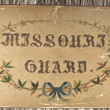
Flag of the Missouri Guard, Company G of the 1st Regiment
(Download 1.9 MB PDF)
(Download 1.9 MB PDF)
Topics