The Civil War in Missouri
Save ThisMy CollectionDred Scott
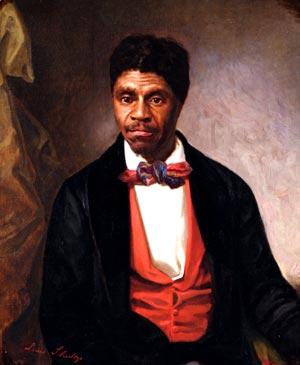
Dred Scott (Download 1 MB PDF)
- The Dred Scott case destroyed the delicate agreement between slave and free states and created national anger that helped lead to the Civil War.
Early Years
Highlights
- Dred Scott was born enslaved. He was considered another person’s property.
- During this time in history some states were considered free and some were slave. Slaves who went to a free state became free. Dred Scott went with his master, Dr. John Emerson, to Illinois and Wisconsin, which were free areas because of a measure called the Missouri Compromise.
- Because he had traveled to free places Dred Scott felt he should be free, and asked the Court to grant him and his wife Harriet that right. He sued for his freedom at the courthouse in St. Louis.
In-Depth
Dred Scott was born enslaved. He was considered another person’s property. Eventually he became the “property” of Dr. John Emerson, who was a surgeon in the U.S. Army. Dr. Emerson’s job took him all over the country to states like Illinois, Louisiana, Florida, and even Wisconsin which wasn’t even a state yet. During this time in history some states were considered free and some were slave. Slaves who went to a free state became free. Dred Scott went with his master, Dr. John Emerson, to Illinois and Wisconsin, which were free areas because of a measure called the Missouri Compromise. Because of this Dred Scott felt he should be free, and he asked the Court to grant him that right. In other words, he sued for his freedom.
The Trial
Highlights
- The case was argued all the way from St. Louis to the Supreme Court. Justice Roger B. Taney said that the government could not make states free anymore and that slavery could spread across the country. Then he said that slaves were not citizens and could not sue for their freedom. It looked like Dred Scott would be enslaved forever.
In-Depth
The trial took a very long time. It began in 1846 and didn’t end until 1857. Dred Scott had friends who hired a lawyer for him, and his lawyer wrote a brief that told the court that Dred Scott had traveled to a free state and deserved his freedom. He also said that many other slaves had sued for their freedom and won, so Dred Scott could do the same because a precedent had been set. Dr. Emerson had passed away by this time so his wife hired a lawyer to defend her right to have Dred Scott as her slave
The judge, Roger B. Taney, sided with Dr. Emerson’s wife. He believed that the Constitution guaranteed people the right to enslave others. He said that the government could not make states free anymore, and that slavery could spread across the country. Then he said that slaves were not citizens and could not sue for their freedom. It looked like Dred Scott would be enslaved forever.
Final Outcome
Highlights
- After the court trial Dred Scott was sold to his friends the Blow family, who gave him and his wife their freedom. This was a fortunate outcome, but the public’s reaction to the trial was very negative. It upset the delicate peace that had been worked out in Congress and fueled anger between the North and the South, and eventually would be a leading cause of the Civil War.
- After being freed Dred Scott worked as a porter. Sadly, he died of tuberculosis in September 1858, just 17 months after gaining his freedom.
Vocabulary
Sue - to institute legal proceedings, or bring suit.
Precedent - an earlier example of something.
Primary Source
Dred Scott (Download 1 MB PDF)
Topics