The Civil War in Missouri
Save ThisMy CollectionMarmaduke's Missouri Raids, 1862–1863
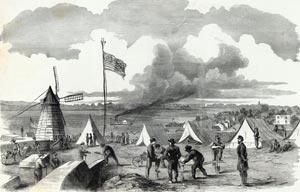
"Cape Girardeau, MO, an Important Strategic Position on the Mississippi" (Download 1.8 MB PDF)
- Between 1862 and 1863 General John S. Marmaduke engaged in two raids into Missouri. While both were turned back, they kept loyal Missourians in a constant state of fear and encouraged pro-South guerillas who operated inside Missouri.
Marmaduke’s First Raid: Background
Highlights
- In early December 1862, the Union Army of the Frontier, led by General James Blunt, advanced into Arkansas.
- In an attempt to stop the Union army the Confederate general Thomas Hindman ordered his cavalry division, led by Gen. Marmaduke, to attack into Missouri at the “rear and flank” of the Union army.
- He hoped that this would disrupt their supply line and force them to retreat.
In-Depth
In early December 1862, the Union Army of the Frontier, led by General James Blunt, advanced into Arkansas. They pursued the Confederate army, which was led by General Thomas C. Hindman. The two armies fought at Cane Hill, Arkansas, resulting in large casualties on both sides. Ultimately, the Confederates retreated under cover of darkness.
The Union army pursued them after burying their dead. In an attempt to stop the advancing Union army, the Confederate general Thomas Hindman ordered his cavalry division, led by General John S. Marmaduke, to attack into Missouri at the “rear and flank” of the Union army, but avoid a “general engagement.” He hoped that this would disrupt the Union’s supply line and force them to retreat.
Marmaduke’s First Raid: The Raid
Highlights
- Gen. Marmaduke acted quickly. After crossing into Missouri, Marmaduke received word that Springfield was lightly defended.
- Disregarding his orders not to incite any major engagements, Marmaduke seized the opportunity to not only force the Union to retreat out of Arkansas, but also force them to stay out until new defenses could be constructed at Springfield.
- He attacked Springfield on January 9, 1863, but Union forces held their ground. As night fell, Marmaduke retreated, believing that Springfield would soon be reinforced.
- He moved on to Hartville, where Colonel Samuel Merrill and a force of Union troops attacked him. After fierce fighting, Marmaduke secured a path of escape and returned to Arkansas.
In-Depth
Gen. Marmaduke acted quickly. He divided his army of roughly 3000 into smaller parts to make it easier to forage, but also to confuse the Union troops. Their goal was to disrupt the supply line somewhere between the railhead at Rolla and the supply depot at Springfield.
After crossing into Missouri, Marmaduke received word that Springfield was lightly defended. Disregarding his orders not to incite any major engagements, Marmaduke seized the opportunity to not only force the Union to retreat out of Arkansas, but also force them to stay out until new defenses could be constructed at Springfield. He took two of his three columns and marched on Springfield. The final column, commanded by Col. Joseph Porter, had marched north and taken Hartville, but did not receive the message from Marmaduke to head to Springfield.
Springfield was commanded by Gen. Egbert Brown. With strength of 2099 troops he was seriously outnumbered by Marmaduke’s force, and much of the force he had was untried militia. When Marmaduke attacked they were able to hold Springfield until nightfall.
In the morning, Marmaduke mistakenly believed that the Union had been reinforced in the night. He also had concerns that the Army of the Frontier might attack him from behind. He made the decision to call off the attack and continue cutting communication lines to Springfield as planned.
Marmaduke united his force with Porter’s at Marshfield and received word that Union troops were approaching to surround him. Meanwhile, a Union force under Colonel Samuel Merrill arrived in Hartville. The two forces met on the morning of January 11, 1863. Marmaduke’s forces were unable to dislodge Merrill from his position, but as night fell the Union forces retreated. This allowed Marmaduke to secure a path for withdrawal, and he removed his force to Arkansas.
Marmaduke’s Second Raid: Background
Highlights
- Almost immediately after the end of his first raid General Marmaduke began planning a second, using the lessons learned from the first. His opportunity came in the spring of 1863. His objectives were:
- to draw Union troops away from Fayetteville, reducing pressure on Confederates;
- to stop the possibility of Union troops being sent to support Gen. Ulysses Grant at Vicksburg or Gen. William Rosecrans in Tennessee;
- to get more supplies and recruits.
Marmaduke’s Second Raid: The Raid
Highlights
- The second raid of Gen. Marmaduke began on April 18, 1863.
- He planned to split his army of 5000 men into two columns and trap Gen. John McNeil’s force at Bloomfield between them.
- McNeil received word of Marmaduke’s movements and retreated to Cape Girardeau.
- Marmaduke pursued him and engaged in four to five hours of artillery bombardment before retreating to Jackson and then back to Arkansas.
In-Depth
The second raid of General Marmaduke began on April 18, 1863. He split his force of 5,000 men into two columns led by Col. George Carter and Col. Joseph Shelby. Planning to attack Gen. John McNeil at Bloomfield, Missouri. Colonel Carter’s column marched toward the city while Gen. Marmaduke accompanied Col. Shelby to Fredericktown to intercept McNeil if he attempted to retreat to Pilot Knob.
McNeil received word that Marmaduke was making his way toward Fredericktown, and he retreated to the heavily fortified Cape Girardeau before Carter arrived. Disobeying orders not to pursue McNeil unless he retreated to Pilot Knob, Carter directed his column to follow McNeil. Marmaduke joined Carter at Cape Girardeau, where a minor engagement erupted, involving four to five hours of artillery bombardment.
Finally, Marmaduke ordered a retreat to Jackson and then back to Arkansas. McNeil with reinforcements pursued the fleeing enemy, engaging in minor skirmishes until they reached the border. Once they crossed the border and the St. Francis River at Chalk Bluff Marmaduke was able to turn the Union forces back from his superior position on a crest above the river.
Primary Source
"Cape Girardeau, MO, an Important Strategic
Position on the Mississippi" (Download 1.8 MB PDF)
Position on the Mississippi" (Download 1.8 MB PDF)
Topics