The Civil War in Missouri
Save ThisMy CollectionMartial Law
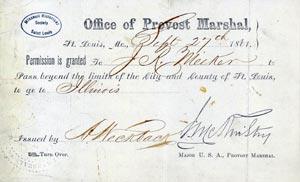
Military Pass Granting J.R. Meeker Permission to Pass Beyond the Limits of St. Louis (Download 494 KB PDF)
- Martial law in Missouri was supposed to suppress Union enemies.
- The abuses and corruption it created led to a great deal of anger and fueled gangs of Bushwhackers and guerrillas who wrought havoc on Union soldiers and citizens.
Imposing of Martial Law
Highlights
- Martial law in Missouri began in August of 1861 by the order of General John C. Frémont. Under martial law the military, not civilian courts, has the power to administer justice.
- This power was executed in a variety of fashions including random arrests, assessments or taxes, banishments, and even loyalty oaths.
- These actions were executed by provost marshals in each county. They were often corrupt, and in some cases did little more than plunder and get revenge.
- Officials, including Pres. Lincoln, felt these policies were necessary in order to protect law-abiding citizens and preserve order.
In-Depth
Martial law in Missouri began in August of 1861 by the order of General John C. Frémont. Under martial law the military, not civilian courts, has the power to administer justice. General Frémont’s order drew criticism from Pres. Lincoln. He was not upset because Frémont imposed martial law, but because Frémont’s order had also allowed for the execution of guerrillas and emancipation of the slaves of secessionists. Frémont’s emancipation order mirrored the one Lincoln would enact in a few years, but in 1861 Lincoln feared this action would create anger in a border state already threatened by Confederate takeover.
The emancipation order was drawn back, but martial law remained. This power was executed in a variety of fashions including random arrests, assessments or taxes, banishments, and even loyalty oaths. These actions which were executed by provost marshals in each county, who were often corrupt, and in some cases amounted to little more than plunder and revenge. However, officials, including Lincoln, felt these policies were necessary in order to protect law-abiding citizens and preserve order.
Assessments/Confiscations
Highlights
- The practice of assessments in Missouri began almost as soon as martial law had been declared.
- The assessments averaged around $200 although some were much higher. Those who could not pay would have property of equal value confiscated and sold at auction.
- Problems plagued the program of assessments. The major problem was that members of the Board of Assessments used their positions to exact revenge rather than simply prove disloyalty.
- In many areas the program backfired and encouraged guerrilla activity.
In-Depth
The practice of assessments in Missouri began almost as soon as martial law had been declared. A system was needed to ensure that only those who were truly disloyal were targeted, and that no one was abused. General Henry Halleck took on this task. In his General Order No. 24 he identified specific levels of disloyalty, which called for different types of punishment. He appointed boards of citizens to determine disloyalty, and used the money raised to fund relief services. Gen. Halleck’s successor, Gen. John Schofield, would expand the program around the state. The assessments averaged around $200 although some were much higher. Those who could not pay would have property of equal value confiscated and sold at auction. Problems plagued the program of assessments. The major problem was that members of the Board of Assessments used their positions to exact revenge rather than proving disloyalty. In many areas the program backfired and encouraged guerrilla activity.
Banishments
Highlights
- By spring of 1863 banishments had become the primary tool for dealing with disloyalty. Banished individuals were usually sent to the Confederacy.
- The policy became problematic as some people were banished for simple kindnesses such as bringing aid to Confederate prisoners of war.
- However, disloyalty was a very real problem. In St. Louis, secret societies, like the Order of American Knights, conspired against the Union.
In-Depth
By spring of 1863 banishments had become the primary tool for dealing with disloyalty. The program of banishments was started by Gen. Schofield. Many family members of Confederates were banished, including Lily Frost (Gen. Daniel Frost’s wife). These banished individuals were usually sent to the Confederacy. The policy became problematic as some people were banished for simple kindnesses such as bringing aid to Confederate prisoners of war. However, disloyalty was a very real problem. In St. Louis, secret societies, like the Order of American Knights, conspired against the Union.
Primary Source
Military Pass Granting J.R. Meeker Permission to Pass
Beyond the Limits of St. Louis (Download 494 KB PDF)
Beyond the Limits of St. Louis (Download 494 KB PDF)
Topics