The Civil War in Missouri
Save ThisMy CollectionMilitary Prisons
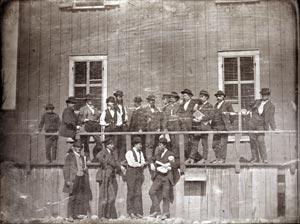
Lynchs Slave Market (Download 1.2 MB PDF)
The prisons in St. Louis were different from many other Union prisons.
- They held not only Confederate prisoners of war but also political prisoners, civilians, Southern sympathizers, and Union deserters.
- Throughout the war and after, they were criticized for being in poor condition, overcrowded, and full of disease.
Myrtle Street Prison
Highlights
- The slave pen operated by Bernard Lynch was the first military prison in St. Louis. It became known as Myrtle Street Prison.
- It was a two-story brick building that could hold about 100 prisoners.
- Myrtle Street Prison accepted its first prisoners in September of 1861. Myrtle Street remained open through the end of the war, usually housing around 145 prisoners.
In-Depth
The slave pen operated by Bernard Lynch was the first military prison in St. Louis. It became known as Myrtle Street Prison. It was taken from Lynch after he joined the Confederacy. It was a two-story brick building that could hold about 100 prisoners, although it would hold many more during periods of the war.
Myrtle Street Prison accepted its first prisoners in September of 1861. Less than a year later, in May of 1862, it was closed and its prisoners were transferred to Gratiot Street Prison. The old slave pen was deemed clean enough to be a prison. However, by November of 1862 the overcrowding at Gratiot Street Prison required the reopening of Myrtle Street with 150 prisoners. Myrtle Street remained open through the end of the war, usually housing around 145 prisoners.
Gratiot Street Prison
Highlights
- A new facility was needed when Myrtle Street Prison became overcrowded. The McDowell Medical College building was turned into Gratiot Street Prison in December 1861.
- Generally, Gratiot Street Prison, like Myrtle Street, served as a holding place for prisoners until they could be transferred to larger facilities.
- The prison was closed in 1865, but portions remained standing for many years. Both Gratiot and Myrtle Street prisons were torn down during a period of urban renewal.
In-Depth
Gratiot Street Prison served as McDowell Medical College before the war. The head of the college, Dr. Joseph McDowell, was well known in the St. Louis community as a doctor. He was also known for his strange behavior and outspoken support for the South. Dr. McDowell acquired two cannons that he kept at his college. He would instruct his students to fire them on holidays. On one such holiday he dressed in a colonial-style three-cornered hat and instructed his students to “make Rome howl.”
When the war broke out, McDowell made his way to the Confederacy, taking his cannons with him. As with many known Southern sympathizers his property was taken and became a barracks. Not long after, word came that 2,000 prisoners of war were on their way to St. Louis. A new facility was needed when Myrtle Street Prison became overcrowded. The McDowell Medical College building became Gratiot Street Prison in December 1861. Generally, Gratiot Street Prison served as a holding place for prisoners until they could be transferred to larger facilities.
Gratiot was unique because it held not only Confederate prisoners of war, but also Southern sympathizers, political prisoners, mail runners, bridge burners, and even Union deserters. In many cases they were placed in the same rooms together. The prison was closed in 1865, but portions remained standing for many years. Sadly, both Gratiot and Myrtle Street prisons were torn down during a period of urban renewal.
Alton Prison
Highlights
- The Alton Prison began as an Illinois state prison, which was closed in 1857.
- By December of 1861 the overcrowding of Myrtle Street and Gratiot Street prisons had grown so bad that Major General Henry W. Halleck sent prisoners of war to Alton on February 9, 1862.
- The prison had 256 cells, but at one point was so overcrowded that it held 5,000 Confederate prisoners. This type of overcrowding led to all sorts of problems, from escapes to disease.
- The end of the war brought the end of Alton Prison. The prison was closed in 1865 and the building was burned.
In-Depth
The Alton Prison began as an Illinois state prison. By 1847 the prison became the focus of prison reform groups because of its horrible conditions. In 1857, the prison was closed. That was four years before the Civil War even started. By December of 1861 the overcrowding of Myrtle Street and Gratiot Street prisons had grown so bad that Major General Henry W. Halleck began thinking about sending prisoners of war there. On February 9, 1862, he did just that.
The prison had 256 cells, but at one point was so overcrowded that it held 5,000 Confederate prisoners. This type of overcrowding led to all sorts of problems, from escapes to disease. The end of the war brought the end of Alton Prison. The prison was closed in 1865 and the building was burned.
Conditions in the Prisons
Highlights
- St. Louis–area prisons were often criticized as being dirty, crowded, and full of disease. They often failed inspections.
- Overall however, conditions in St. Louis–area prisons appear to have been better than their Confederate counterparts. Still, they remained miserable and dangerous places.
In-Depth
St. Louis–area prisons were often criticized as being dirty, crowded, and full of disease. They often failed inspections. People’s opinions of the prisons were based on whose side they were on. Unionists in St. Louis viewed the prisons as just fine. Reverend Galusha Anderson, a strong Unionist who often visited the prisons, said nothing was wrong with their conditions.
However, Griffin Frost, a Confederate prisoner, described Gratiot Street Prison as “a very dark gloomy place” and “an excellent place to starve.” Overall, conditions in St. Louis–area prisons appear to have been better than their Confederate counterparts. Still, they remained miserable and dangerous places.
Vocabulary
Barracks - a building or group of buildings for lodging soldiers.
Prisoners of war - people taken by or surrendering to enemy forces in wartime.
Urban renewal - the rehabilitation of city areas by renovating or replacing dilapidated buildings with new housing, public buildings, parks, roadways, industrial areas, etc., often in accordance with comprehensive plans.
Primary Sources

Lynchs Slave Market (Download 1.2 MB PDF)
Alton Prison (Download 1.1 MB PDF)

Gratiot Street Prison (Download 1.6 MB PDF)
Topics