The Civil War in Missouri
Save ThisMy CollectionOrder of American Knights
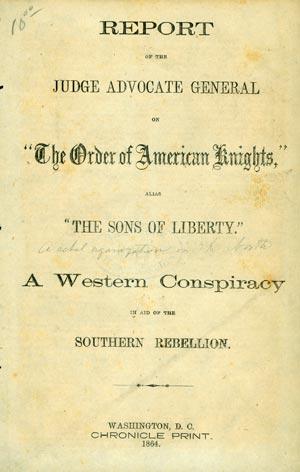
Order of American Knights Report (Download full document, 27 MB PDF)
- Throughout the war, stories were told of secret organizations and conspiracies. In Missouri legends ran wild with tales of the Order of American Knights.
- These tales became legitimized when Colonel John P. Sanderson and his detectives uncovered and published evidence of this secret group.
- While his evidence turned out to be greatly exaggerated it served to help Republicans defeat Peace Democrats in the election of 1864.
Overview
Highlights
- The Order of American Knights (OAK) was founded by Phineas C. Wright, a struggling New Orleans lawyer, in 1856.
- It remained a theoretical organization until Wright moved to St. Louis in 1860 and redefined the goals of the OAK. It was then designed to protect civil rights, promote the movement to end the war, and provide protection for Democrats against the Union or Lincoln Leagues, organizations that began around 1862 to promote loyalty to the policies of Abraham Lincoln.
- Wright eventually succeeded in establishing a handful of temples in Illinois, Indiana, New York, and Missouri.
- The temples met in Chicago in December 1863, but the poor showing caused many to doubt the organization. Eventually, Wright’s poor leadership caused the group to collapse.
In-Depth
The Order of American Knights (OAK) was founded by Phineas C. Wright, a struggling New Orleans lawyer, in 1856. It was originally established with vague goals of combating sectionalism and preaching conservative politics. It remained a theoretical organization until Wright moved to St. Louis in 1860.
In the city his outspoken opposition to the policies of martial law and Lincoln’s initial Emancipation Proclamation made him a target of military officials who accused him of secessionist sympathies and forced him to take a loyalty oath.
After this experience Wright redefined the goals of the OAK. It was then designed to protect civil rights, promote the movement to end the war, and provide protection for Democrats against the Union or Lincoln Leagues. This final goal made Wright suggest that an armed military wing might be necessary to protect citizens.
Wright eventually succeeded in establishing a handful of temples in Illinois, Indiana, and New York as well as Missouri. The temples met in Chicago in December 1863, but the poor showing caused many to doubt the organization. Eventually, Wrights poor leadership caused the group to collapse.
Organization
Highlights
- The organization was led by a supreme council made up of the grand commanders of each state and run by a supreme commander, the first of which was Wright himself.
- Each state was run by a grand council led by a grand commander. In Missouri, the grand commander was Charles L. Hunt, a lawyer in St. Louis. Charles E. Dunn was his deputy grand commander, and Green B. Smith was the grand secretary.
- Below them there were individual temples that formed by decree of the grand council.
OAK in Missouri
Highlights
- In Missouri, the St. Louis temple earned the focus of Colonel John P. Sanderson, a politician who was appointed provost marshal general in the Department of the Missouri under General William S. Rosecrans.
- He employed detectives, several of whom claimed to have formerly been rebel officers.
- Eventually, the undercover detectives met Charles L. Hunt, who told them that there were 8,000 members in St. Louis and 23,000 in Missouri—numbers refuted by historians. He also told them that he was the leader of the organization.
- In response to this and numerous rumors and conspiracies Sanderson arrested Hunt and Dunn as well as a few other suspected members and accused them of secessionist activities.
- Rosecrans released a report by Sanderson to several newspapers that used the allegations of conspiracy to help Republicans in the polls. This helped lead to the Peace Democrats’ defeat.
In-Depth
In Missouri, the St. Louis temple earned the focus of Colonel John P. Sanderson, a politician who was appointed to the Department of the Missouri under General William S. Rosecrans. Sanderson wanted to redeem his reputation because he lacked a military background and had been accused of cowardice at the Battle of Chickamauga. This desire combined with a growth in support for Peace Democrats encouraged his investigation into the rumors of the existence of the Order of American Knights.
He employed detectives, several of whom claimed to have formerly been rebel officers. Eventually, the undercover detectives met Charles Hunt, who told them that there were 8,000 members in St. Louis and 23,000 in Missouri—a number refuted by historians. He also told them that he was the leader of the organization. In response to this and numerous rumors and conspiracies, Sanderson arrested Hunt and Dunn as well as a few other suspected members and accused them of secessionist activities.
Rosecrans and Sanderson then tried to meet with Pres. Lincoln, who sent his personal secretary, John Hay, to see what they had uncovered. Mostly unconvinced, the War Department ordered the release of several of the prisoners. Angry about this, Rosecrans released Sanderson’s report to several newspapers that used the allegations of conspiracy to help Republicans in the polls.
Finally, just before the election in 1864 the War Department ordered the writing and release of a report by Judge Advocate General Joseph Holt that supported Sanderson’s findings. This helped lead to the Peace Democrats’ defeat.
Vocabulary
Peace Democrats- any citizens in the North who opposed the war policy and advocated restoration of the Union through a negotiated settlement with the South.
Primary Source
Order of American Knights Report
(Download full document, 27 MB PDF)
(Download full document, 27 MB PDF)
Topics